

What is scoliosis?
Scoliosis is a sideways curvature of the spine of more than 10°, resulting in the formation of an abnormal bend – a curve – in the spine. Scoliosis can be structural – true scoliosis, which is in fact a disease of the spine – or postural, which develops as a consequence of altered biomechanical relationships elsewhere in the body, for example a leg-length difference or a tilted pelvis.
Structural scoliosis can be divided, according to the age at which it appears, into early-onset scoliosis, which occurs in children up to 10 years of age, and adolescent scoliosis. By far the most common is adolescent idiopathic scoliosis, which typically appears in girls with a right-sided thoracic curve. Because structural scoliosis is a three-dimensional deformity, the sideways curvature is always accompanied by rotation of the vertebra, as well as torsion of the entire spine, so a typical posterior rib prominence – a rib hump (gibbus) – can be seen in children. The cause of adolescent idiopathic scoliosis is unknown, but genetics has been shown to have the most important influence. Essentially, the key factor in the development of adolescent idiopathic scoliosis is uneven – uncoordinated – growth of the vertebra between its anterior and posterior parts. Specifically, the anterior part of the vertebra (the vertebral body) grows faster than its posterior part (the vertebral arches), which causes the vertebra to rotate. Other factors mentioned as possible causes of adolescent idiopathic scoliosis include an early growth spurt, reduced bone mineral density – osteoporosis, a large leg-length difference, and the development of the muscles alongside the spine. Parents often say their children sit or stand with poor posture, or take part in asymmetric sports, and see this as the reason for the scoliosis. However, these circumstances do not affect the occurrence of scoliosis.
How is scoliosis diagnosed?
Children and parents usually come in for a spinal examination after noticing poor posture, a bump on the back, asymmetry in shoulder height, or back pain. Sometimes the child has none of the symptoms listed above, but is referred to a paediatric orthopaedic specialist following a school screening examination. The vast majority of children who come in for a spinal examination report no complaints at all, but if pain is present, its character should be investigated in detail. Particular attention should be paid to the onset and duration of the pain, and its effect on the appearance of the spine. For example, sudden-onset back pain that causes an abnormal posture may be a sign of infection or a tumour, but also of an intervertebral disc injury or spondylolysis (a stress fracture of the vertebral arch). In girls, it is important to find out the age of the first menstrual period (menarche), since spinal growth is considered to be most pronounced one year before and two years after menarche, and it is precisely during this period of most intense spinal growth that the greatest curvatures develop.
On clinical examination of the spine, the most important step is the forward bending test (Adam's test), during which the contours of the spine are observed and asymmetry is looked for. In typical adolescent idiopathic scoliosis, a larger prominence – a rib hump – is seen on the right thoracic side, and a smaller prominence, representing muscle asymmetry, on the left lumbar side. Clinically, the height of the iliac crests is generally symmetrical. If a greater asymmetry in the height of the iliac crests is found, a leg-length difference should be suspected; wooden blocks should be placed under the shorter leg and the spine re-examined in forward bending. A leg-length difference of up to 2 cm is considered to have no effect on the occurrence of structural scoliosis. However, a leg-length difference can easily lead to pelvic tilt and, consequently, to postural scoliosis, which can be corrected simply.
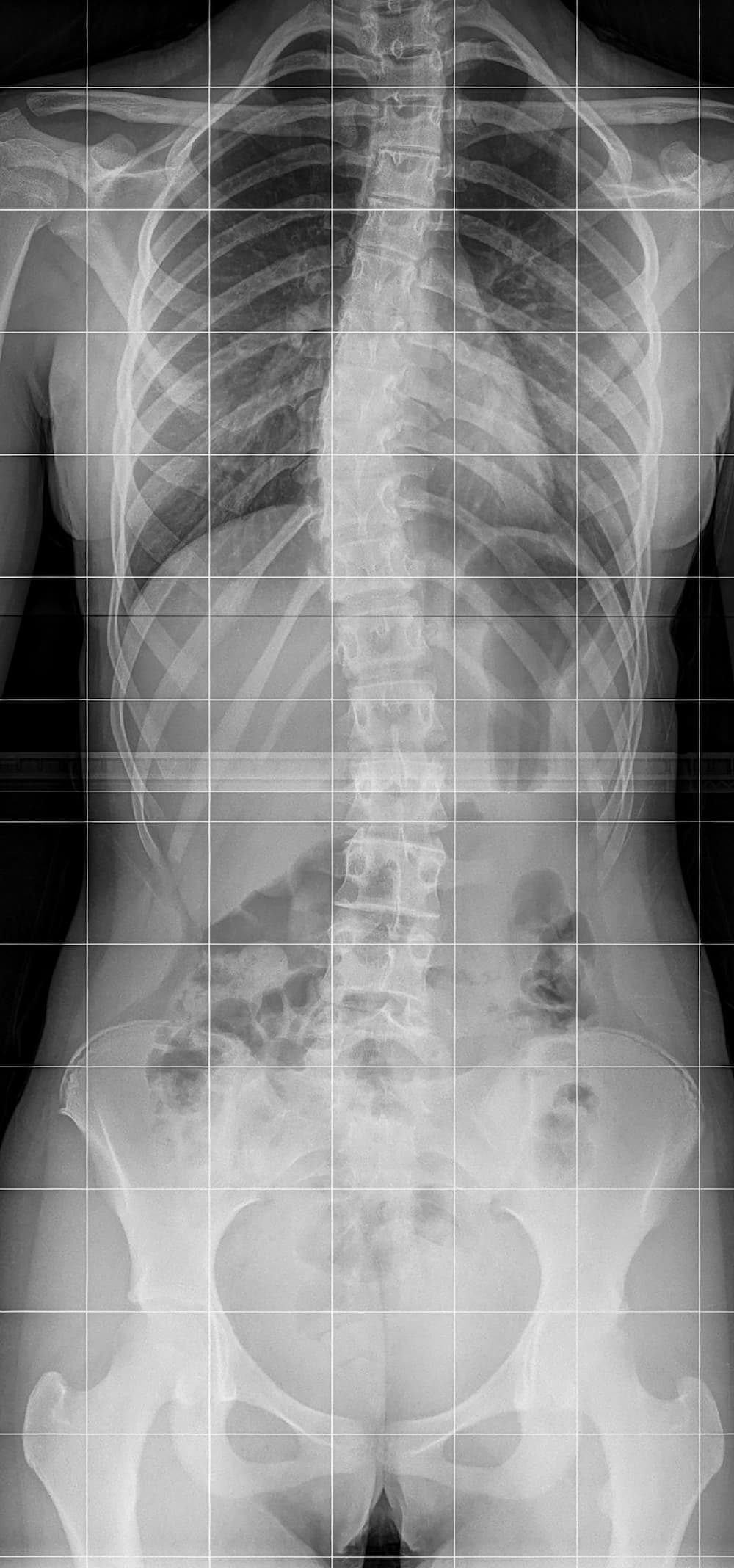
At every spinal examination, attention should also be paid to the front of the chest, looking at the relationship between the rib arches and the sternum. Sometimes pectus carinatum – a pigeon chest – or, conversely, pectus excavatum – a funnel, sunken chest – is noted. Children should be asked to walk on their toes and heels to rule out a neurological deficit. The basic radiological imaging of the spine when scoliosis is suspected is a spinal X-ray in the PA (postero-anterior, viewed from behind) projection. Children must stand on their feet and be barefoot for the X-ray, and ideally the same X-ray should show both the spine and the iliac crests, figure 1. If the X-ray shows a lateral curvature of the spine of 11° or more by the Cobb method, the child has scoliosis. According to orthopaedic criteria, a lateral curvature of up to 10° is not considered scoliosis in the full sense of the word. The same X-ray should also be used to assess bone maturity at the iliac crests, from which overall skeletal maturity is estimated – something that is extremely important when choosing the correct treatment. As mentioned earlier, painful scoliosis that has also developed suddenly may be a sign of other conditions requiring urgent treatment. For this reason, sudden-onset, painful scoliosis should be urgently referred for an MRI scan, in order to better visualise the structure of the vertebrae as well as the soft tissues around the spine.
How is scoliosis treated?
The most important prognostic factors for adolescent idiopathic scoliosis are:
- the Cobb angle
- the child's age
- skeletal maturity
- for girls – the first menstrual period
A younger age and a larger Cobb angle at the time adolescent idiopathic scoliosis is discovered are considered to increase the likelihood of worsening, so scoliosis worsens in 80% of children if, at the time of diagnosis, the lateral curvature is more than 25° by Cobb.
There are three main goals in treating adolescent idiopathic scoliosis: to stop the scoliosis from worsening, to correct the curvature of the spine, and to maintain the corrected shape of the spine. Every child with scoliosis should be referred for specific physical therapy. Sporting activities should also be recommended, ideally swimming. However, the most important thing is to involve the child in a sport they are motivated to do. Since adolescence is a sensitive period of maturation for young people, excessively imposing activities that children do not want to do can have a negative effect on their willingness to take part in sport.
If, at the time adolescent idiopathic scoliosis is discovered, the lateral curvature measures more than 20° by Cobb and skeletal maturity is not yet complete – that is, the child still has growth potential – a spinal brace should be included in the treatment. A spinal brace is fitted according to the three-point pressure principle, correcting the spine by directing the forces of spinal growth in the corrected direction. The brace's main task is to stop the scoliosis from worsening, and in some cases up to 20% correction of the scoliotic curvature can be achieved. When prescribing a brace, it is necessary to talk carefully with the child, since during this sensitive period of their life they must wear something they may feel disfigures their appearance. It is therefore important to explain in detail the principles of brace treatment for scoliosis, and in particular to stress that the brace should be worn for as much of the day as possible, at least 16 hours a day.
Children being treated for scoliosis should be monitored clinically, but also with a spinal X-ray at least once a year. If the scoliotic curvature worsens beyond 40° in the thoracic segment or 50° in the lumbar segment of the spine, surgical treatment should be considered. Surgery stops the growth of the spine, but also corrects the scoliotic curvature through spinal fusion – arthrodesis – techniques.
A much rarer type of scoliosis, early-onset scoliosis (occurring up to the age of 10), should be actively treated as soon as the diagnosis is confirmed. These children undergo spinal correction using casting, which can gradually be replaced by a plastic brace. The basic idea is to achieve as much spinal growth as possible in the correct direction before surgery, since surgery essentially stops the growth of the spine by fusing the vertebrae together and stiffening the spine. Unfortunately, this type of scoliosis always requires surgical treatment, since it progresses rapidly and compromises breathing.
Postural scoliosis is treated by correcting the static alignment – equalising the leg-length difference. Orthopaedic insoles are usually made for both feet, with the thicker one placed under the shorter leg to functionally lengthen it. If the leg-length difference is greater than 2 cm, orthopaedic shoes with a built-up sole matched to the desired height correction need to be made. A leg-length difference can also be treated surgically: if the child is still growing, the growth of the longer leg can be slowed – or stopped – or, once growth has finished, the shorter leg can be lengthened. Alongside correction of the static alignment, physical therapy should always be started – stretching exercises for the muscles around the pelvis and thighs.
For more information or to schedule an appointment, please get in touch via the contact form.
Book Appointment