
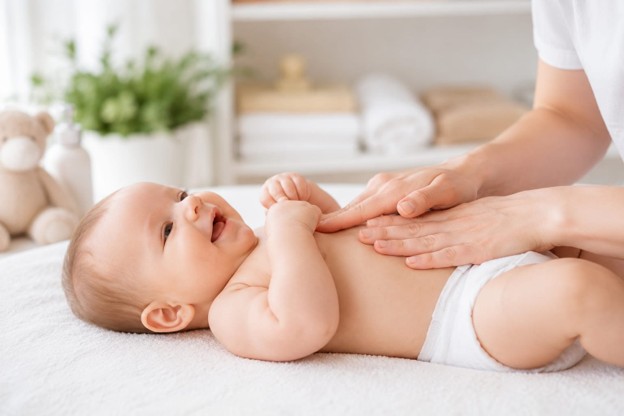
What is baby massage?
As the name suggests, massage is applied to babies using gentle movements of the hands. Besides strengthening the emotional bond between parent and child, massage performed correctly can have a positive effect on a baby's general condition. Pleasant touch is considered to contribute to a sense of security, reduce stress levels, and help regulate sleep and the baby's behaviour. It is important to stress that massage is not a substitute for medical treatment but rather a form of additional care when carried out correctly.
What are the benefits of baby massage?
Regular massage can positively influence a child's psychophysical development. Gentle touch encourages the development of the sensory system, while at the same time contributing to the formation of a secure attachment between baby and parent. During massage, mutual interaction increases, which can help parents better recognise their child's needs. In some babies, massage can help relieve discomfort associated with gas and mild digestive issues, especially when performed with circular movements on the abdomen in a clockwise direction. Massage can also have a positive effect on sleep quality and ease of settling, particularly in babies who are fussy or have difficulty falling asleep.
How to massage a baby correctly?
Massage is best carried out when the baby is awake, relaxed and content. If the baby is crying, unsettled or avoiding eye contact, it is best to skip the massage. The room should be warm enough, and the hands of the person giving the massage should be clean and warm. Movements should be slow, gentle and adapted to the baby's reactions. Organic cold-pressed sunflower oil is recommended, as it is the least allergenic, does not clog pores, and has a high content of linoleic acid, which helps form a protective layer on the skin. Before use, check whether the baby has an allergic reaction – place a drop of oil on the baby's wrist and wait about 10 minutes. The baby is positioned on their back between the legs of the person giving the massage. This position allows eye contact to be maintained, making it easier to follow the baby's reactions during the massage. Sometimes the baby will be in the mood for the whole massage routine, and sometimes only part of it. For example, the tummy can be massaged during a nappy change, and the legs during play. It is not a problem if the massage lasts only a few minutes – as long as it is done well.
When should a baby not be massaged?
Massage should be postponed if the baby has a raised body temperature, an acute infection, jaundice, diarrhoea, skin damage, cuts, open wounds or bruises. It is advisable to postpone massage for 48 hours after vaccination, or until local sensitivity and possible side effects have passed. Likewise, massage over a surgical site should only be carried out on a doctor's recommendation. Similarly, if the baby is not in the mood for a massage, postpone it until the baby feels comfortable.
How often should a baby be massaged?
There is no strict rule on how often a baby may be massaged, as this primarily depends on the child's needs and daily routine. Most babies do well with a short massage lasting 10 to 15 minutes, several times a week or daily if they enjoy it. More important than duration is that the massage takes place when the baby is relaxed and ready to cooperate. Massage should never be unpleasant or painful. Over time, parents usually learn to recognise the moments when their baby responds best to touch, and massage becomes an enjoyable part of everyday care and bonding.
For more information or to schedule an appointment, please get in touch via the contact form.
Book Appointment